One Website for a Multi-Advisor Travel Agency: Brand, Profiles, and Lead Routing
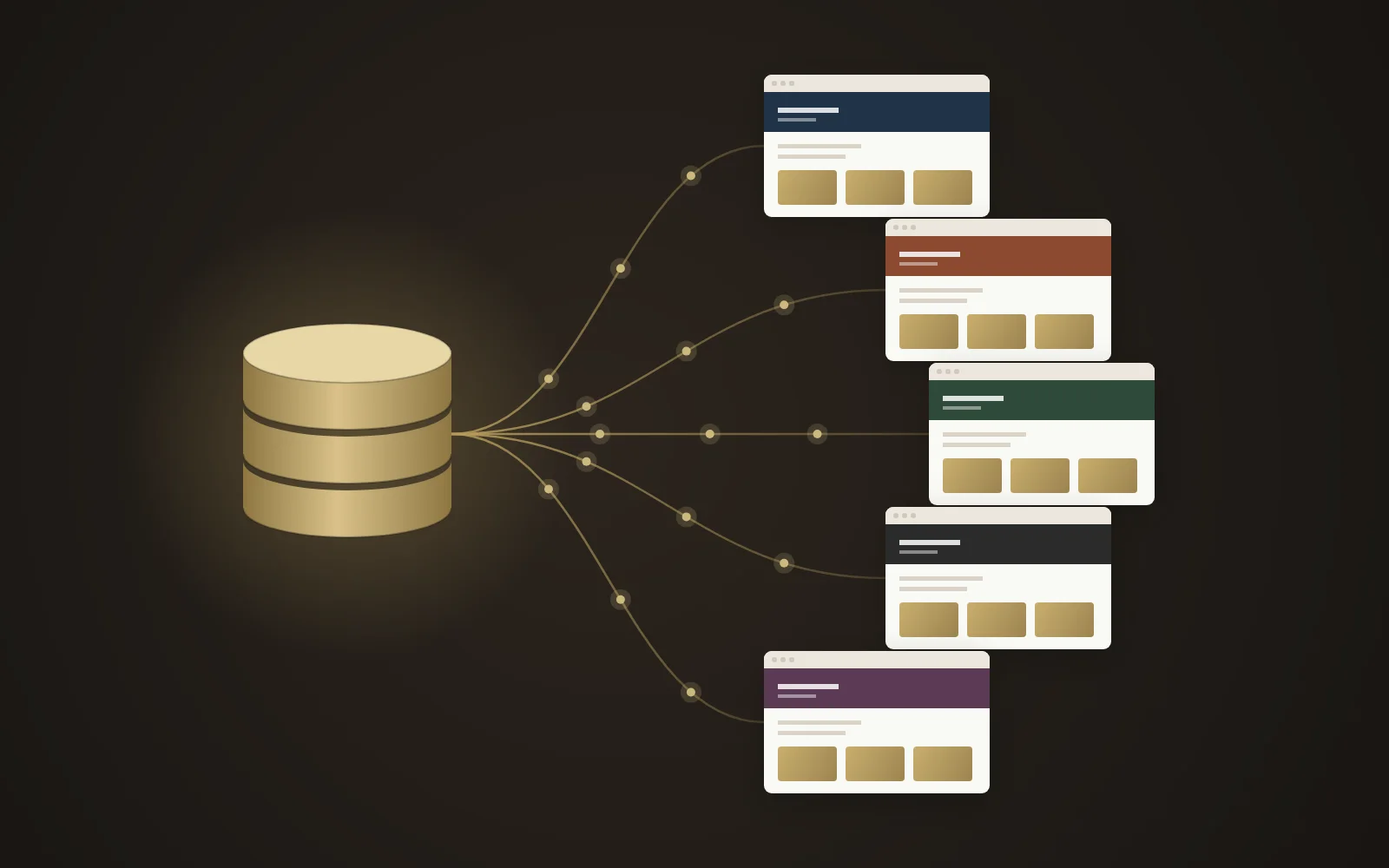
A multi-advisor travel agency needs one website that does two jobs at once: present the agency as a single, credible brand, and give every advisor a page of their own that a client can find, read, and contact directly. The structure that works is a shared brand site with an advisor directory, a profile page for each advisor, inquiries routed to the right person automatically, and content published under both the agency's name and the advisor's.
Most agencies arrive at something else. Each advisor builds a separate site, or the agency site lists names with no way to reach anyone in particular. Both lose referrals. Here is how to structure it properly.
Key Takeaways
- Clients choose an advisor, not an agency. The site has to make each advisor findable while keeping one brand standard.
- A directory with individual profile pages lets a referral search for one advisor's name and land on the right page.
- Inquiries should reach the advisor the client chose, without the owner forwarding emails.
- Shared content and one bill keep the brand consistent and the operations simple as the team grows.
- Advisors can run their own brand on their own domain and still stay consistent with the agency, as long as every site draws from one source of truth.
Why do multi-advisor agencies struggle with their websites?
Because the agency and the advisors want different things from the same site. The owner wants a consistent brand that signals quality across the whole team. Each advisor wants clients to find them specifically, because their referrals ask for them by name.
When the site serves only the agency, a referral who searches for an advisor's name finds a general page and a generic contact form. When each advisor runs a separate site, the brand fragments: different designs, different levels of polish, and a client who cannot tell the advisors belong to the same firm. Neither version shows a prospect what the agency actually is, which is a group of specialists working to one standard.
What should a multi-advisor agency website include?
Five things, built into one site rather than added later:
| Component | What it does |
|---|---|
| Agency brand site | One design, one domain, one standard for every page |
| Advisor directory | Every advisor listed with specialties, searchable by destination or travel style |
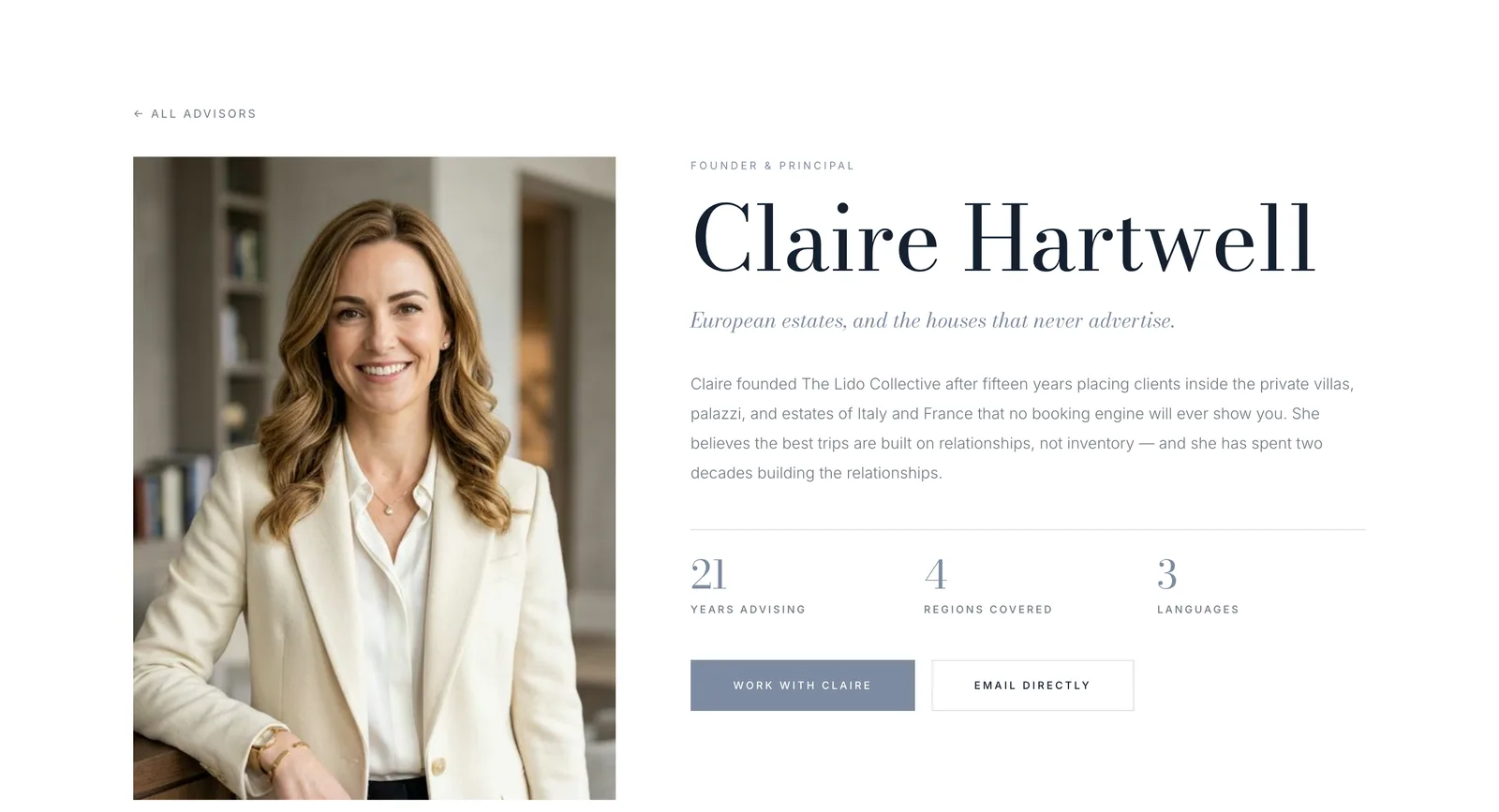
| Advisor profile pages | A page per advisor with their bio, specialties, and a direct inquiry form |
| Per-advisor lead routing | Inquiries from a profile page go straight to that advisor |
| Shared content library | Editorial published under the agency, with posts attributed to individual advisors |
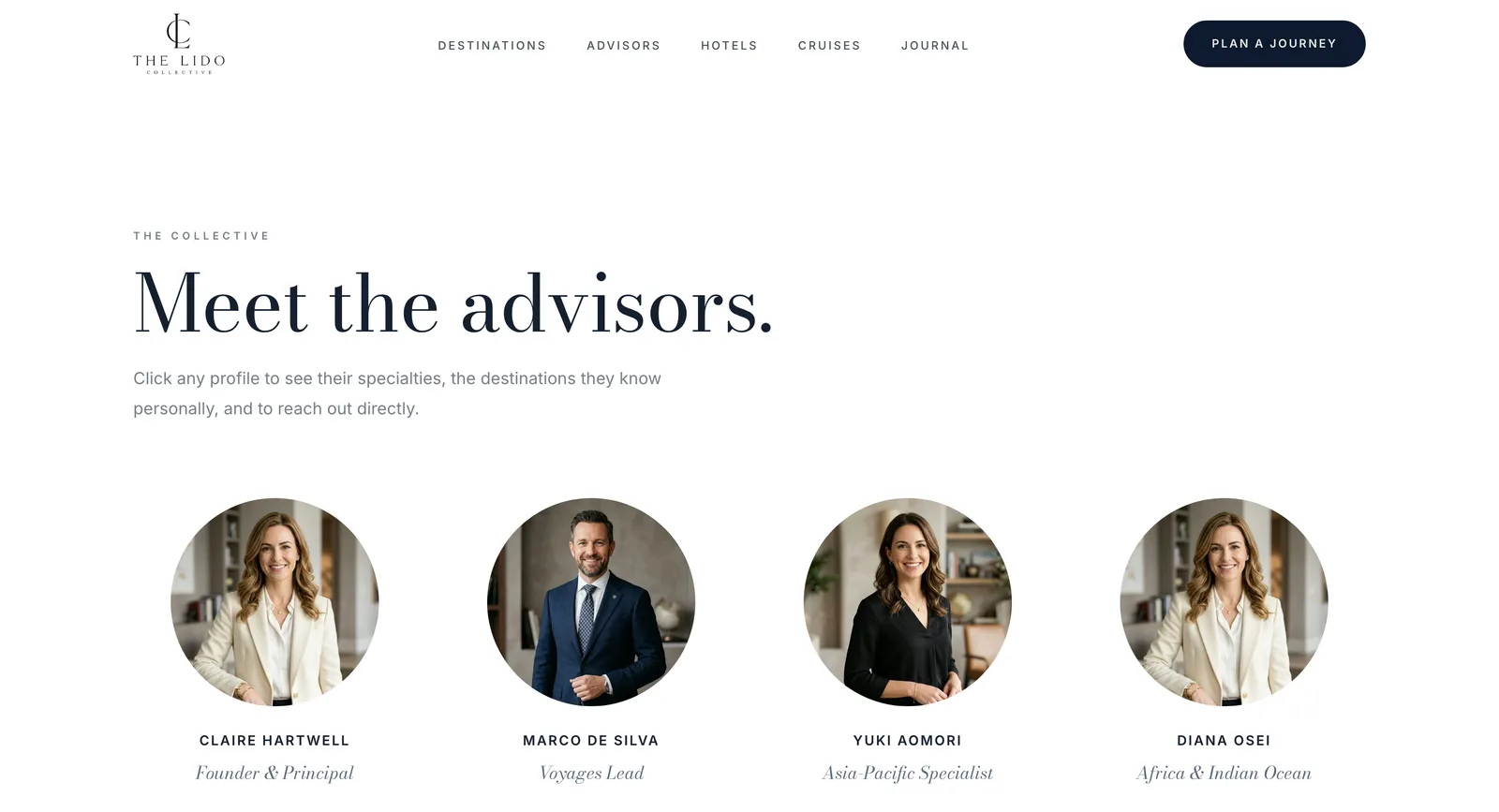
The profile page is the most important piece. It is where a referral lands after searching an advisor's name, and it is the page that has to convince them in the first few seconds. It should look as considered as the agency's home page, not like a staff listing.
How should inquiries be routed between advisors?
By the page the client contacts from. An inquiry sent from an advisor's profile page should go to that advisor, with the agency able to see it. An inquiry from the general contact page should go to whoever the agency designates for new business.
This sounds obvious, and it is where many agency sites fail. A single shared inbox means the owner sorts every lead by hand, response times stretch, and a client who asked for a specific advisor waits while their message is forwarded. In luxury travel, the first response sets the tone for everything that follows.
How do you keep a brand consistent across many advisors?
Make consistency the default rather than a rule people have to follow. When every advisor's page is built from the same design system, with the same typography, photography standard, and supplier catalog, the brand stays consistent without the owner reviewing every change.
Content works the same way. Editorial published under the agency, with posts attributed to individual advisors, builds the agency's authority and each advisor's profile at once. It also keeps the site current, which matters for search and increasingly for AI engines that favor sites that are maintained.
Can advisors keep their own brand and domain under an agency?
Yes, and many agencies prefer it. An advisor with an established following often wants a site under their own name and domain: their logo, their colors, their voice. The agency wants every one of those sites to be accurate, current, and recognizably part of the same firm. Both are possible at once, but only if the sites are built on shared information rather than as separate projects.
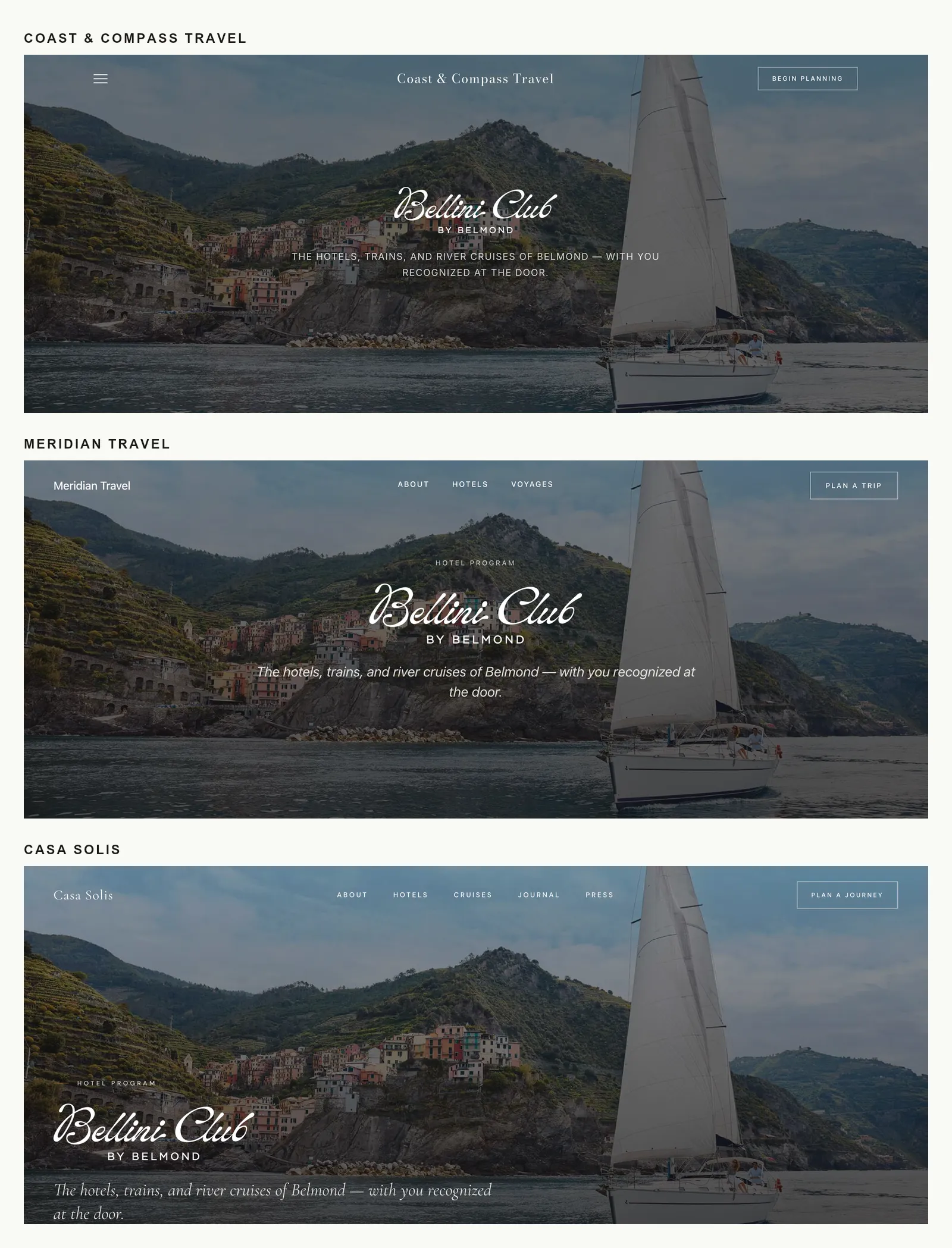
Most agencies run into trouble here. If every advisor site is a separate build, every piece of information is copied into it: hotel descriptions, hotel program benefits, cruise lines, the agency's affiliation. When a benefit changes, someone has to find and fix every copy. Most of the time nobody does, and the sites drift apart until a client notices that two advisors in the same firm describe the same hotel differently.
How does one source of truth keep every advisor site consistent?
Each piece of information lives in exactly one place, and every site reads from it. Each advisor's site shows that information in its own brand, on its own domain. Three layers make this work.
| Layer | What lives there | How it reaches the sites |
|---|---|---|
| Shared catalog | Luxury hotels, preferred hotel programs and their benefits, cruise lines, villas | Maintained once, centrally. Every advisor site reads the same record, so an update appears across the network at once. |
| Shared editorial | Articles written to the agency's standard, organized by category | Published once and delivered to every site that has opted into that category, under each advisor's own brand. |
| Advisor brand and record | Domain, logo, design, name, bio, specialties, contact details, affiliations, chosen hotel programs | Stored once per advisor. It sets how that site looks and fills its home page, profile, journal bylines, contact routing, and search data. |
The first two layers keep the network consistent. When a hotel program changes a credit or adds a property, the change is made once and every advisor's site shows the same current benefit, whatever domain it lives on. When a new article is published, it reaches every site that carries that category on the same day, without anyone copying and pasting.
The third layer keeps each advisor individual. An advisor's site can carry their own name, logo, and design on their own domain, and feature the hotel programs and editorial categories they choose. When they update a specialty or a phone number, they change it once and every page on their site updates together.
The result is a network that behaves like one portfolio. Advisors present their own brand. The agency keeps the facts consistent. One console covers every site, one catalog feeds them, and one bill covers them all.
Building it on Elite Advisor Hub
The Agency plan on Elite Advisor Hub is built for exactly this structure: multiple advisors under one agency brand, an advisor directory with a profile page per advisor, per-advisor lead routing, every affiliate site managed in one place, co-authored editorial with two posts a week per advisor, white-label branding, and unified billing. Setup is $4,999, and the monthly fee is quoted on the number of advisor sites. Every site runs on the same maintained catalog of 1,795+ luxury hotels, preferred hotel programs, and cruise lines, and advisors who want their own brand can run it on their own domain while drawing from the same catalog and editorial as the rest of the agency.
Questions
- Should each travel advisor in an agency have their own website?
- Every advisor should have at least their own page. For most, a profile page on the agency site, with its own URL, bio, and inquiry form, is enough. Advisors with an established following can run a full site under their own brand and domain, which works well when it draws from the same shared catalog and editorial as the agency.
- How do I route website inquiries to individual advisors?
- Route by the page the inquiry comes from. A form on an advisor's profile page should deliver to that advisor, with the agency able to see it. General inquiries go to the person handling new business.
- What is an advisor directory on a travel agency website?
- A listing of every advisor in the agency, with photos, specialties, and destinations, that clients can browse or search. Each entry links to the advisor's profile page and contact form.
- How do multi-advisor agencies keep their brand consistent?
- By building every advisor page from one design system and one supplier catalog, so consistency is the default. Shared editorial attributed to individual advisors keeps the voice aligned while giving each advisor visibility.
- Can travel advisors in an agency have their own website and domain?
- Yes. Each advisor can run a site under their own name, logo, and domain while drawing supplier content and editorial from the same shared source as the rest of the agency. The sites look individual, and the information on them stays consistent.
- How do you keep information consistent across several advisor websites?
- Store each piece of information once and let every site read from it. Supplier content such as hotels, hotel program benefits, and cruise lines lives in one shared catalog, editorial is published once to every site that carries it, and each advisor's details live in one record. An update made once appears across the whole network.
A website built for the top 1%.
A custom-branded advisor site on your own domain, with the supplier catalog and curated editorial kept current for you. Live within days.